
Nano Microporous Insulation Pad For EV battery cell-to-cell thermal barrier
Product description
Nano microporous material is pressed into 1–5 mm thick sheets to form a thermal protection layer for the space between cells in new-energy-vehicle traction batteries. The pad withstands high temperature and combines strong flame resistance with high insulation performance, improving pack safety by slowing thermal runaway and thermal propagation and buying time for the safety system to act. It also provides insulation in low-temperature operation to help limit range loss.
Applications
| Position | Function | Typical thickness |
|---|---|---|
| Between cells | Blocks heat, flame and particle jet from a failing cell reaching its neighbour; absorbs cell swelling over charge–discharge cycles | 1–3 mm |
| Between modules | Stops propagation across module boundaries and compensates assembly tolerances | 2–5 mm |
| Pack cover and bottom | Thermal and fire barrier toward the occupants and the vehicle underbody | 2–5 mm |
| Energy-storage cabinet | Barrier between cells and racks in ESS, where large-format cells increase released energy | 2–5 mm |
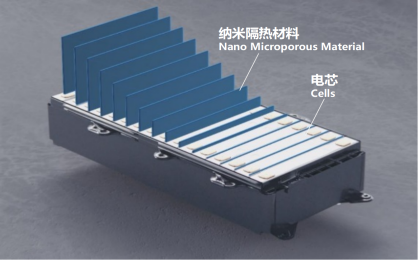

Features
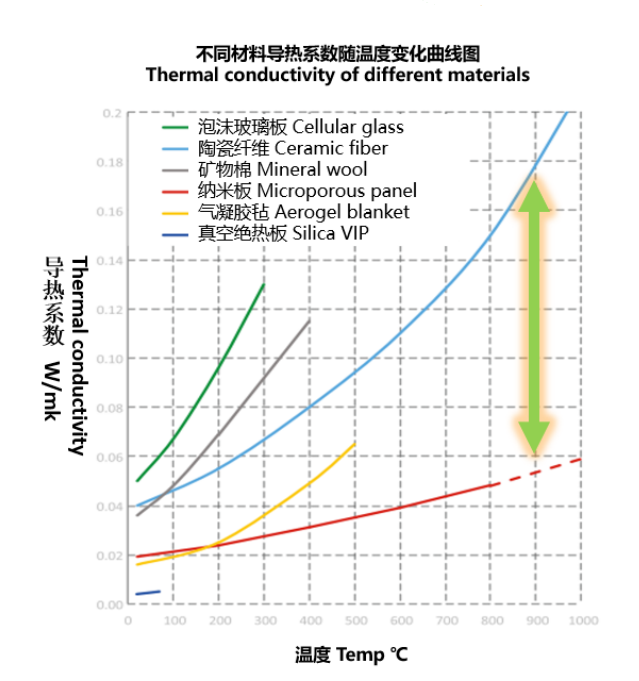
- High insulation efficiency — excellent at ambient temperature; at 800 °C its insulation performance is 4× that of conventional materials.
- Thin and light — for the same insulation performance the layer is thinner, releasing usable space inside the pack.
- Stable structure — keeps its structure at high temperature, resisting shrinkage and deformation.
- Fire resistance and heat tolerance — A1 non-combustible material, service temperature up to 1000 °C.
- Dielectric stability — the bare pad withstands 3500 V DC with maximum leakage current ≤ 0.1 mA.
- Environmentally friendly — no pollution; produces no harmful gas or smoke in a fire environment.
Technical specifications
| Property | Value |
|---|---|
| Service temperature | 1050 °C |
| Specific heat capacity | ~0.9 kJ/(kg·K) |
| Density | 300–350 kg/m³ |
| Thermal conductivity at 200 °C | 0.022 W/(m·K) |
| Thermal conductivity at 400 °C | 0.024 W/(m·K) |
| Thermal conductivity at 600 °C | 0.030 W/(m·K) |
| Thermal conductivity at 800 °C | 0.033 W/(m·K) |
| Linear shrinkage at 850 °C, 24 h | ≤ 0.3 % |
| Linear shrinkage at 950 °C, 24 h | ≤ 1.0 % |
| Maximum leakage current | ≤ 0.1 mA |
| Compressive strength at ambient temperature | up to 0.3 MPa |
| Reaction to fire | A1 non-combustible |
| Standard thickness | 1–5 mm (customisable) |
Values are the manufacturer’s typical test data. Please confirm the final specification with a sample test and a project-specific report before mass production.
Thermal conductivity vs temperature
Insulation principle
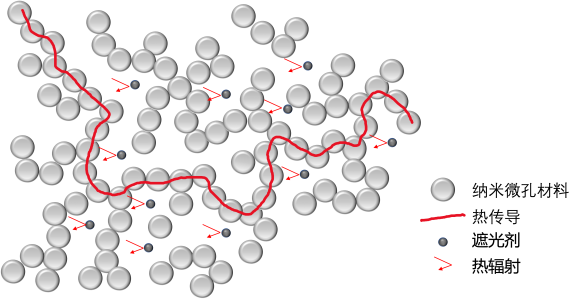
Nano insulation material reduces heat transfer through three routes at once:
- Conduction — heat can only travel through the tiny contact points between particles, so the conduction path is much longer and conduction drops sharply.
- Convection — air molecules in the gaps between particles move far less freely, contributing almost no convective transfer.
- Radiation — an added opacifier absorbs and blocks infrared radiation.
Nano microporous pad vs aerogel blanket
| Aspect | Nano microporous pad | Typical aerogel blanket |
|---|---|---|
| Material make-up | Nano microporous material as the main component — high nano-material content | Largely fibre substrate compounded with a relatively small amount of nano aerogel material |
| Temperature limit | 1000–1050 °C | ~600 °C for conventional grades |
| Performance above 200 °C | Decay with rising temperature is very slow; performance overtakes aerogel above ~200 °C | Decays faster as temperature rises |
| Compressive strength (ambient) | up to 0.3 MPa | ~0.1 MPa |
| Fire classification | A1 non-combustible | Grade-dependent — confirm from the supplier |
| Dielectric strength | Bare pad 3500 V DC, leakage ≤ 0.1 mA | Grade-dependent — confirm from the supplier |
Aerogel figures reflect typical market grades and are given for comparison only. Always compare against a supplier datasheet measured under the same test conditions as your own.
Ordering information
| Item | Options |
|---|---|
| Form | Flat sheet / die-cut part to customer drawing |
| Thickness | 1–5 mm |
| Lamination | PET film / PI film / aluminium foil |
| Backing | Adhesive with release liner (optional) |
| Sample | Available for customer-side module test |
Data available on request
- λ vs temperature curve
- Compression stress–strain curve in your assembly range
- Sample for module-level propagation testing
ZeroThermo · Sichuan ZeroThermo Technology Co., Ltd. · Duofu Industrial Park, Linjiang New Area, Nanchong, Sichuan, China · www.zerothermovip.com
Data source: in-house test reports. Content reviewed 2026-10-08.


